18th Century Women Life

During the eighteenth century, married women lives revolved to a large extent around managing the house hold a role which in many cases in running farms or home businesses. The English rule of life in many ways and how woman responded to events surrounding them. The role of most women to be managing all aspects of their households. Even those women took up spining and other activities replace imported goods. In the early days they prepared food for militia musters and made cartridges. When war come and touched everyone and destroyed farms and homes so, some women were able to continue to manage homes, farms but others unable to survive on their own and follow their husbands with the army. Women who traveled with the army were known as camp followers and to provide for themselves at home; fear of attack; eviction by troops; desire to be with husbands; the attraction of a paying job and rations. Women were an important element because they carried out tasks such as laundering and nursing which men were unwilling to do and army would have been even more seriously depleted by disease. In addition, women performed cooks, food foragers, spies and water carriers. Women and accompanying children used scarce rations and slowed the movement of the army. Nevertheless, they were performed important jobs for the welfare of the armies and for fear that the men would desert if their families were sent home.
By: BUSHRA BADER MADOUKH...
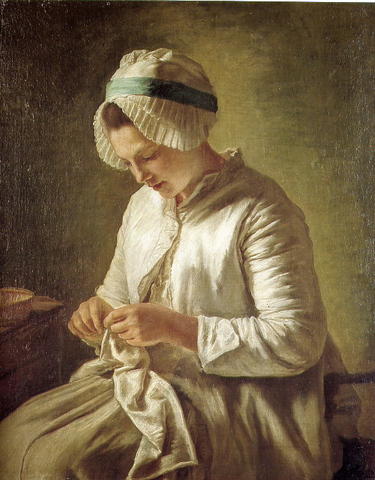
The women life in 19th century
life in 19th Century
During the nineteenth century women were viewed as homemakers, she was not able to perform in society with men. They were abuse and treated by men to believe that they were worth almost nothing, only worthy giving birth to children and to cook and to clean. This male control lead to many women feeling trapped in their own homes. There were novels like "The Yellow Wallpaper" by Charlotte Perkins Gilman, talk about that. In her short story Gilman portrays herself as a woman who is suffering from post-partum depression. The woman is locked away from society in a confined room, only to drive herself more insane. The author uses this nameless narrator in attempts to gain her position against the gender problems and break down the problem of men control. Throughout "The Yellow Wallpaper," Gilman challenges the reader to question feminist stances and gender boundaries of the 19th century using specific symbols of gendered spaces, but also uses these devices to allow the reader to become connected with the facts of life women experienced during this time. Women in the 19th Century had many reasons to be frustration.
By:Reem Alfaize
There is a great difference between women's status and position in the 18th century and the 19th century. This is because the view of women's role in social is determined by the political and social condition. In addition the intellect and thoughts of the male gender help in performing this vision. Moreover women's calls for their rights play an important role in forming their status in society. So we see that there is a great change in women's role and status from the 18th century till now.
During the 18th century women weren't allowed to have formal education like men. They were kept at home. The upper class women who had a desire and determination to complete their education went to school until the high school only. They could increase their knowledge through private tutors.As a result, woman occupied them sews by managing the household in running farms or home business. They were dependent on their husband financially the extent that most of them traveled with their husbands in the war. They stayed in camps to carry out tasks such as laundering and nursing.
Which men were unwilling to do? In addition, they performed duties such as kooris, food forager spies and water carriers. So women weren’t independent. They didn’t have role except the house hold because men appreciated women who were inferior to them. Concerning the political side, women weren’t allowed to hold any political position. In addition, they weren’t allowed to work in certain jobs such as medicine and law. In the social life, women were forbidden to possess anything or even inherit. So they were deprived from any financial sources to support themselves. So they were dependent to their husbands financially. Thus marriage was considered the only way for women to secure themselves. So they gave great interest in fashion and marriage. Mothers occupied themselves in marrying their daughters to rich men to secure their daughters. In literature, women weren’t allowed to publish their literary work. As a result many female writers changed their names such as: George Eliot. She was a female writer who took a male name to publish her works. So womb in the 18th century didn’t have any role or value in society.
There were some similarities and differences between women status in the 18th and the 19th centuries. The first similarity was that women were expected to marry and have children. The British laws were based on the ideas that women world get married and their husbands would take care of them. So women had become dependent to their husbands .Another similarity is that males expected women to be faithful to then and did their best to provide their husbands with comfort. Husbands believed that it was female's duty to comfort their husbands from the stresses of the Industrial World. After marriage, it was difficult for women to obtain divorce because it was against the British laws even if she discovered her husband unfaithful. If divorced took place, the children become the man's property and the mother could be prevented from seeing her children. Concerning the fields of work, the only paid occupation open to women in the 19th century was to become a governess with a miserable salary. None of the professions were open to women. There were no women in government offices, no secretarial work done with them. They had small opportunities to work as nurses but this was also disorganized and women to support themselves. So the society deprived women from most if their rights especially in the political field. They were prevented to vote in the parliament In addition, she didn't have the chance to enter the world of politics. So they didn't have separate identity in the society.
To conclude, Women's position and status in society were decided according to the amount of education and knowledge she receives. Also, the political and social lows put limitations to her role in society. Thus, they were suffering from inequality with men. But their status improved during the 19th century when they began to possess. This achieved an amount of financial independence but it wasn't a complete freedom. It was under the control of their husbands.
By: Alanoud Alyahya & Sara Almohareb
Women status and low
Robert Burton said that England was "a paradise" (Jarret 134). Paradise seems like a great place to live, until you look at the saying more closely and realize that women and horses are both living out their days in the style provided them by men, their master.The low were dramatically based on: marital property, primogeniture, and the parameters under which heirs were selected. English common law, favored children over widows and son over daughters. The ownership of the family estate was shared by both spouses and favored the rights of the widow over those of her children.
Women by the death of the husband her status is declined in the family. Under the English common law, the growth of the commercially and individualistic have seen in the society.
Girls at this time care only about the handsome young not about his character. Some young men, in order to agree marrying girls to have money (annual income). They were thought, drawing, swing, dancing, singing, placing music, etiquette, which prepare them to be house women. They could not have advanced education, no jobs. Women were not allowed to express their feelings. Parties, dancing were the only entertainment at the time.
Lucy Aikin wrote about the role of women: the absurd idea that the two sexes ever can be or ever ought to be placed in all respects on a footing of equality. Man when he abuses his power itself is no tyranny being founded not on usurpation, but on certain unalterable necessities; sanctioned not by prescription alone, but the fundamental laws of human nature. Clever women who wrote novels like Jane Austen, George and Eliot were not acceptable by the society. People thought that women supposed to be shy not too badly to man's face. Women could not buy or sell by themselves. They could not vote because they are not educated.
Jane Austen in her pride and prejudice defending about women satirizes the attitude of marriage based on money and beauty, but which based on personality, romance, mutual understanding, respect and similarity of feelings and taste...
Women who traveled with army were known as camp followers and did so far many reasons: inability to provide for themselves at home; fear of attack; eviction of a paying job and rations, or in some cases as cutlers selling to the army.In addition, women performed duties as cooks, food forgers, spies and water carries. They performed important jobs for the welfare of the armies and for that the men would desert if their families were sent home.
In spite public censure and harsh critics, some women did speak out about the problems facing "the weaker sex". Marry Wollstonecraft discussed the "innocent state" in which women. Moralists pretend to assert that this is the condition in which one half of the human race should be encouraged to remain with listless inactivity and inactivity and stupid acquiescence?
Kind instructors! What were we created for? To remain, it may be said, innocent they mean in astute of child hood we might as well never have been born, unless it were necessary that we should be created to enable man to acquire the noble privilege of reason, the power of discerning good from evil, whilst we lie down in the dust from whence we were taken, never to vise again.
BY: Rasha Saud Alshehry
Women in the 18th c & 19th Century
Women used to play an important role in society but the situation changed during the 18th and the 19th century. Their status changed according to the political, social and educational conditions. In addition, marriage laws at that period affect women's position in societies. The lack of education forced women to become dependent to their families, before marriage and to their husbands after marriage. Also the social laws were against the development of women's role in society.There are some similarities and differences between the 18th and the 19th century.
In the 18th century, women didn't have any influential role in society. They were deprived from most of their rights especially education. In Europe, the society emphasized that education of the female children was a family responsibility.The social laws didn't give the women the right to receive formal education at school. The upper class families used to bring private tutors to their houses to provide the female children what they need from knowledge and experience. As a result, they received limited amount of knowledge which control their position and rank in society. The social roles and laws emphasizes that women weren't allowed to hold certain positions in society such as medicine or law. Moreover, the males appreciate women with limited amount of education in order to make them dependent.
Marriage occupies one of the priorities for almost all women in the 18th century .It's considered the only way to a achieve security and safety to women. So women were slaves to their husbands because they didn't have any source of incomes. They weren't allowed to have a financial independence. Good marriage is regarded as success. In addition, some families saw that the female acquired an education that included practical, literary and ornamental skills. These included cooking, sewing and the other household. Moreover males encouraged them to give great interest in trivial such as fashion, music, and drawing and dancing. While middle class families trained their daughters the skills of running a family business such as keeping tavern from which some proficiency in reading and writing . In addition to that they imitated the upper class in paying for music and dance lesson .For the low class females; they were trained to do the jobs at hand. They didn't have time to spend in reading and writing. While slave women were trained to do useful skills to their masters. Education wasn't among those skills. The 18th c women weren't allowed to receive inheritance from her families. All women's property was belonged to their husbands. So the only means of security was getting married to wealthy husbands. Concerning the literary field, female writers weren't allowed to publish their writing, so some of them call themselves male name to publish their works.
During the 19th c, women status differed completely. The Victorian women achieved her independence. They hadn't become dependent to their husbands or families. To prepare for marriage women had to get ready by learning some skills such as singing, playing an instrument and speak a little French or Italian. Whether married or single , all Victorian women were expected to be weak , helpless and fragile .They were expected to perform their duties as mothers and wives .So gentlewomen emphasized that home was the place for comfort for her husband and family from the stress of the Industrial world. Concerning the financial independence, the European societies put laws that allowed women to own her property inherited from her family. During the 19th c, if a wife separated from her husband, she lost her right to see her children. In addition, the society didn't accept the divorced women.
The similarity between the 18th C and the 19thc was in the way that women were treated before and after marriage. In the field of work, women weren't allowed to occupy certain position such as the government professions. They were prevented from working as secretary's .The only work which was available to them was nursing but it was also disorganized. This made a small opportunity for women to be independent. So, marriage was still the only way to achieve security for women.
Another similarity between the 18th & 19th c is the duties and performances that were allowed to women. Males appreciated women who had high talents in fashion, music and drawing. They didn't value the women of intellect. So they focused their attention in making women ignorant and away from any social activities. Also, the government doesn't give the women the chance to vote or to be included at any political contribution. All the development that happened to women is giving her the right to publish her literary works by her real name which is prohibited in the 18th c. This shows the birth of the female writers and their attitudes towards the social conditions in their societies. The female writers tried to discuss women's social status and the inferior view towards her.
IN CONCLUDES women's status and position changed from generation to the other. They were deprived from all their rights during the 18th c but she gained some of them in the 19thc. Women's positions in society was determined by the political and the social rules of society , so women were suffering during the 18thc but her position improved during the 19thc when she achieve a little of her financial independence to support herself.
English Law in the 18th Century
The criminal justice system of in the 18th century was so strict about the punishment. Prosecution of almost all criminal offenses was private, usually by the victim. It is only a slight exaggeration to say that, in the early years of the century, English courts imposed only two sentences on convicted felons. Either they turned them loose or they hanged them.
In the 18th century they had no public officials corresponding to either police or district attorneys. Constables were unpaid and played only a minor role in law enforcement. A victim of crime who wanted a constable to undertake any substantial effort in order to apprehend the perpetrator was expected to pay the expenses of doing so. Attempts to create public prosecutors failed in 1855 and again in 1871 when the office of Director of Public Prosecution was finally established in 1879, its responsibilities were very much less than those of an American district attorney, now or then. In 18th century
Under English law, any Englishman could prosecute any crime. In practice, the prosecutor was usually the victim. It was up to him to file charges with the local magistrate, present evidence to the grand jury, and, if the grand jury found a true bill, provide evidence for reimbursed, or reimbursed in full, even when the defendant was convicted-and not all defendants were convicted. Not until 1778 did it became possible for a prosecutor to be reimbursed for an unsuccessful prosecution.
In some ways, their system for criminal prosecution system of civil prosecution. Under both, it is the victim who ordinarily initiates and controls the process by which the offender is brought to justice.
Such conclusions must be qualified by the fact that the eighteenth century data reflect homicide indictments, not homicides. If the fraction of homicides resulting in indictments felt sharply from 1660 to 1800, that could explain the data without any decrease in the murder rate
The 19th Century Law
During the early 19th century, the Poor Law was often heavily criticized because it's discourage the unemployed from seeking work, while at the same time placing an enormous burden upon the ratepayer. This study encompasses the difficult period of transition between the Old and New Poor Law which took place in the 1830-40s.
There is an Act to Relief the Poor was passed which was to be the basis of Poor Law administration for the next two centuries. It divided the poor receiving relief into three categories.
1) The able bodied who were to have work provided for them
2) The rogues, vagabonds, and beggars, who were to be whipped or otherwise punished for their unwillingness to work
State and federal laws that discriminated against women posed some of the most significant obstacles to securing women’s rights. The earliest campaigns to improve women’s legal status in the
Women Rights in the Nineteenth-Century
Rights of women during most of the nineteenth century were dependent upon their marital status. Once women married, their property rights were governed by English common law, which required that the property women took into a marriage, or acquired subsequently, be legally absorbed by their husbands. Furthermore, married women could not make wills or dispose of any property without their husbands' consent. Marital separation, whether initiated by the husband or wife, usually left the women economically destitute, as the law offered them no rights to marital property. Once married, the only legal avenue through which women could reclaim property was widowhood. Women who never married maintained control over all their property, including their inheritance. These women could own freehold land and had complete control of property disposal. 1840 Elizabeth Cady Stanton spoke out against slavery and in favor of women's right at the World's Antislavery Convention, held in
The Social Position of Women in the 18th century
The pattern of
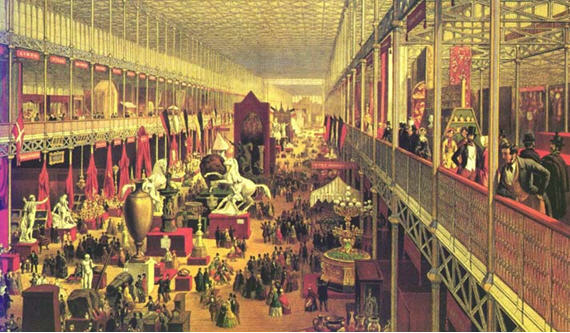
The Social Position of Women in the 19th century
During the latter years of the nineteenth century women, as always, women held an inferior position to men, which usually reflected their social status. Though laws were helping to improve the woman's role in society, she was still confronted with legal, educational, and economic setbacks, By the end of the nineteenth century and the beginning of the twentieth century improvements aided in giving women more rights, and educational and occupational. Earlier on in the century women lacked the rights to own their own property no matter their rank in society. Women were forced to give obedience to their husbands, and had minimal opportunity to be divorced from their without going through numerous explanations and trials in courts. Women usually had to prove more than one offense against their husbands to be granted a divorce. Even cases of rape and maltreatment worked more to the advantage of the husband.
Middle- class women had it much easier than lower class women. More opportunities, more advancement, and more respect. When they did accept women the numbers were limited because women lacked the education to be prepared for any type of higher learning. Movement influenced and led by women like Millicent Fawcett and Emmeline Pankhurst helped lead to the rise of women in society. Other women found jobs in rudimentary school teaching, managing clubs for poor youth, poor young women, and schools for infants. They were able to enjoy many of the new luxuries, inventions, and innovations of the time. Men on the other had were the head of the family, obtained the property rights, had more educational opportunities, and much more legal rights. Society was not for the benefit of women. Omen was encumbered with the fact that they had little chance to go beyond being a house wife. Without access to higher learning institutions women had no chance of advancing their individual social or economic status. If women found it particularly hard to find a job they usually resorted to prostitution, which was legal at the time.over time public literature, such as magazines and books, began to praise the different aspects that women had to undertake. Outside of the workplace women were expected to attend church on a regular basis and make sure that their families, especially children had religious instruction. Many women were illiterate because they were denied any type of primary or secondary education other than care taking.
By: Arwa Al saeed
The 18th century lasted from 1701 to 1800 in the Gregorian calendar . Denoting the period of time between the death of Louis XIV of France and the start of the French Revolution with an emphasis on directly interconnected events . During the 18th century, the Enlightenment culminated in the French and American revolutions. Philosophers were dreaming about a better age without the christian fundamentalism of earlier centuries . The industrial revolution started in Britain . Despite its modest beginnings in the 18th century, it would radically change human society and the geology of the surface of the earth. Philosophy and science increased in prominence . All these factors from wars , revolutions , enlightenment , and the invitation to Christian embracing , have an effects on the literature in this period .

In this century , the novelist women discussed a lot of events their century in their writing , such as ; the poverty , the differences between low classes and high classes , women raping , women's rights and position , women were lock up , tormented and beleaguered by domineering men . For this period of literature , we have example . Eliza Haywood (1693 - February 25, 1756) her origins remain unclear . She married the Rev. Valentine Haywood . She fell ill in October 1755 and died February 25,1756 . She was buried in Westminster . She was an English writer, actress and publisher. Haywood wrote and published over seventy works during her lifetime including fiction, drama, translations, poetry, conduct literature and periodicals. Haywood is a significant figure of the long 18th century as one of the important founders of the novel in English. Today she is studied primarily as a novelist .
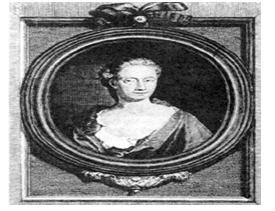
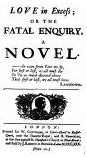
Haywood's writing career began in 1719 with the first two installments of Love in Excess, a novel, and ended in the year she died with conduct books The Wife and The Husband, and the biweekly periodical The Young Lady. She wrote in several genres and many of her works were published anonymously. There is much of Haywood's writing career that still remains unknown .
Haywood's prolific fiction develops from titillating romance novels and amatory fiction during the early 1720s to works focused more on "women's rights and position" . In the middle novels of her career, women were locked up, tormented and beleaguered by domineering men. In the later novels of the 1740s and 1750s however, marriage was viewed as a positive situation between men and women . Due to the economy of publishing in the 18th century, her novels often ran to multiple volumes .
Haywood's first novel , Love in Excess or The Fatal Enquiry (1719-1720) touches on themes of education and marriage. This novel is also notable for its treatment of the fallen woman .
Fantomina; or Love in a Maze (1724) is a short story about a woman who assumes the roles of a prostitute, a maid, a widow, and a Lady in order to repeatedly seduce a man named Beauplaisir . This novel asserts that women have some access to power in the social sphere, one of the recurring themes in Haywood's work .
The Fortunate Foundlings (1744) is a picaresque novel in which two children of opposite sex experience the world differently, according to their gender .
The History of Miss Betsy Thoughtless (1751) is a sophisticated, multi-plot novel that has been deemed the first novel of female development in English . Betsy Thoughtless represents an important change in the 18th century novel .
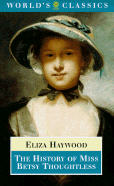
While she was writing popular novels , Eliza Haywood was also working on periodicals , essays and manuals on social behavior . Eliza Haywood was active in politics during her entire career . She had begun to make it known that she was poor and in need of funds, and she seemed to be writing for pay and to please the undiscerning public .
The 19th century began on January 1,1801 and ended on December 31, 1900, according to the Gregorian calendar . In this period , Napoleon enter Spain's capital during the Peninsular War and the British Empire became the world's leading power , controlling one quarter of the world's population and one third of the land area . London was transformed into the worlds largest city and capital of the British . It enfoced Pax Britannica , encouraged trade , and battled rampant piracy . During this time the 19th century was an era of widespread invention . The slave market was greatly reduced around the world . British forced the Barbary pirates to halt their Practice of Kidnapping and enslaving Europeans . A banned the slavery throughout its domain .
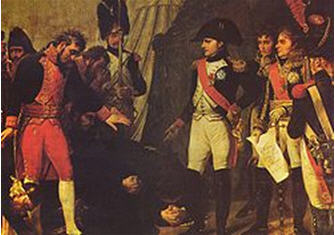
All these factors have an effects on the literature in this period . the novelists became write topics different than topics of 18th century . They became write about the freedom , emotion , nature and love stories ….. etc . Here we have example of novelist woman from this period .
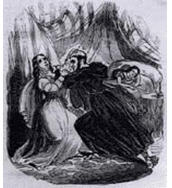
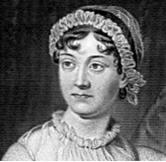
Jane Austen (16 December 1775 - 18 July 1817) was an English novelist whose realism, biting social commentary and masterful use of free indirect speech, burlesque, and irony have earned her a place as one of the most widely read and most beloved writers in English literature .
 .
.
Austen lived her entire life as part of a small and close-knit family located on the lower fringes of English gentry. She was educated primarily by her father and older brothers as well as through her own reading. The steadfast support of her family was critical to Austen's development as a professional writer. Austen's artistic apprenticeship lasted from her teenage years until she was about thirty-five years old. During this period, she experimented with various literary forms, including the epistolary novel which she tried and then abandoned, and wrote and extensively revised three major novels and began a fourth..
From 1811 until 1816, with the release of Sense and Sensibility (1811), Pride and Prejudice (1813), Mansfield Park (1814) and Emma (1816), she achieved success as a published writer. She wrote two additional novels, Northanger Abbey and Persuasion, both published posthumously in 1818, and began a third, which was eventually titled Sanditon, but died before completing it . In 1804, , Austen wrote a novel, The Watsons . Sutherland describes the novel as "a study in the harsh economic realities of dependent women's lives" .
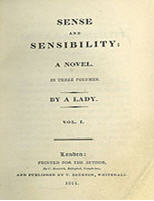
Austen's works critique the novels of sensibility of the second half of the eighteenth century and are part of the transition to nineteenth-century realism. Also , she highlight the dependence of women on marriage to secure social standing and economic security.Like those of Samuel Johnson, one of the strongest influences on her writing, her works are concerned with moral issues .
She chose her writing to publish anonymously, her works brought her little personal fame and only a few positive reviews. Through the mid-nineteenth century, her novels were admired only by members of the literary elite. By the 1940s, Austen was widely accepted in academia as a "great English writer". The second half of the twentieth century saw a proliferation of Austen scholarship, which explored many aspects of her novels: artistic, ideological, and historical in popular culture.
