Ann Radcliffe & Jane Austen
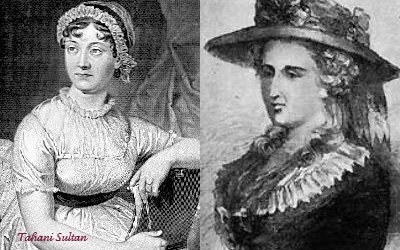
Jane Austen & Ann Radcliffe (their lifes)
Jane Austen’slife:
Jane Austen’s life , by all standards, was so modest and uneventful that it offers very little to write about. She was born at Steventon in Hampshire in 1775. Her father, the Rev. George Austen, the rector of Steventon was reputed to be a man of ‘considerable intelligence and scholarship’. Her mother Cassandra Leigh had ‘a lively mind and a keen sense of humour’. The Austens had eight children, six boys and two girls, Jane being the seventh.The two girls were together sent to a school at Bath and later at Reading. But it was at the parsonage, under the guidance of their father, that they received their earl education. They were encouraged to read and Jane Austen read extensively.Life at Steventon was rather narrow. Visits abroad were few and far between. Nor is it likely that Jane formed any close friendships outside the family circle.Jane Austen never married, nor did Cassandra. Jane did receive a proposal of marriage, but she did not want to marry where she did not love, so she declined the proposal.Jane Austen started writing early when she was in her middle teens. She wrote at first to amuse her family.Her early writings are included in three notebooks entitled Volume the First, Volume the Second, Volume the Third. These writings – short novels, plays, etc. Her first serious work Elinor and Marianne, a novel in the form of letters, was written in 1795 when she was twenty. In 1797, it was recast as Sense and Sensibility. First Impressions, later revised and recast as Pride and Prejudice was written in 1796-97. In 1798 she attempted a satire on Gothic novels in her Northanger Abbey.
Sense and Sensibility was the first among her novels to go to print and this did not happen till 1811.In 1809, the Austens moved to Chawton in Hampshire. Jane Austen resumed her writing. During the next five years , she wrote three more novels – Mansfield Park in 1811-13, Emma in 1814-15 and Persuasion in 1815-16. Her last novel Sanditon was never finished.In 1816, Jane Austen’s health began to deteriorate. On 8th July, 1817, she died in Cassandra’s arms, quite courageously.
Ann Radcliffe’slife:
Ann Radcliffe was born in London(1764). She married William Radcliffe, an editor for the English Chronicle, at Bath in 1788. The couple were childless. To amuse herself, she began to write fiction, which her husband encouraged. She published The Castles of Athlin and Dunbayne in 1789. It set the tone for the majority of her work, which tended to involve innocent, but heroic young women who find themselves in gloomy, mysterious castles ruled by even more mysterious barons with dark pasts. Although most of her novels were set in continental Europe amid majestic landscapes, Radcliffe ironically never traveled to the continent until after she had already written most of her novels.Her works were extremely popular among the upper class and the growing middle class, especially among young women. Their ability to infuse sensations of fear and terror with a quiet, conscientious rationalism appealed tremendously to the literary tastes of her times. Her works included The Sicilian Romance (1790), The Romance of the Forest (1791), The Mysteries of Udolpho (1794), and The Italian (1796 ) ,She died on February 7, 1823 from respiratory problems probably caused by pneumonia.
Jane and Ann (their topics)
Jane Austen's talks about several different topics such as: first begun as a satire on the improbable plots and characters of the typical gothic novel, and it is distinguishing between literature and life, and of education into real life. Another is , in comedy of manners. Also , First Impression because the appearances of the characters created the plot of the novel. Another one , it discovers that the relationships of the people around her, who she has been attempting to dictate, is not at all what they seem. Austen gives us Fanny Price. Finally, Jane Austen combined social satire with profound feeling.
Ann Radcliffe's topic, she talks about several different topics such as: She talks about the residence of the still beautiful widow, a neighboring chief, proud, oppressive, revengeful, and still residing in all the pomp of feudal greatness in her novel. Also, she talks about a romance, and Interspersed with some Pieces of Poetry.
Jane Austen & her difficulties
Jane lived happy childhood in a village of Stevenson in Hampshire. She started wrote her first novel at the age of fourteen. She shocked and suffered when her parents decided to move to Bath. She hated this town, and she had miserable time in it. In Bath, she falls in love and the predestination did not leave her to feel happy with him, the news came to tell her you beloved die.
After Jane's father death, Jane, her mother and her sister Cassandra suffered of financial difficulties. They were relying of her brother and her brother gave them a permanent home on his Chawton estate. After ten years the news comes to tell her that the brother's wife died after she birthed eleven children, so she and Cassandra returned to Hampshire but not to the village but close to it to become mother for the brother's children. So she gave her life to the orphaned children and takes care of them. Jane Austen did not marry because she could not marry without love. At ones she accepted a proposal of marriage, bur she changed her mind and she feel upset of that. Jane Austen had contracted Addisons Disease, a tubercular disease of the kidneys. When the disease intensified Cassandra came to take care of her. She was lean on the arm of her sister; after the children grew and went to school she was still lean until she finally falls on the arms of her sister in eighteenth of the month of July (1817) for (40) years.
Jane Austen style in writing was influenced by some writers and makes the works of them her refrences .one of them is Samue Richardson sir Charlsgrandison was the favourite, and Austen makes an amusing refrence to it in northanger abbey. Jane Austen read a lot of authers works such as fielding (his novels and plays) , also shakespeare and women writers such as Charlotte Lennox,Charlotte Smith Hannah cowley . Also, She read gothic novels she mocks in northanger abbey. She was, at the same time, influenced by William Cowper. He represents feelings and freedom, spontaneity and experiences, individual values and struggles. The influence that William Cowper exerted over Jane Austen can be seen on two different convictions. According to Cowper, knowledge should be gained from life; from the experience you acquire living. Experience is more important than academic education. This idea will be present in Jane Austen's work. Finally, we see all these effects in Jane Austen original and great works such as pride and prejudice, sense and sensibility.
Ann Radcliffe critical canon
Radcliffe had an unparalleled success with all section of readership with both its consumers and critics. Also Radcliffe success in straightforward aesthetic terms. Mrs. Radcliffe as an author has the most decided claim to take her place among the favored few who have been distinguished as the founders of a class or school. This claim by sir Walter Scott was a critical commonplace .It may seem dubious given the manifest nature of her Gothic influence.
In pondering the sources of Radcliffe's powers of enchantment critics referred to her poetic sensibility, her pictorial, scenic art, or her ability to duplicate a sense of the supernatural. In modern critic terms we may say that she helped create a new topography of the self and new readerly hermeneutics.
Their problems and illnesses
Jane Austen is typically described as having excellent health until the
age of 40 and the onset of a mysterious and fatal illness. A medical history
reveals that she was particularly susceptible to infection, and suffered
unusually severe infective illnesses, as well as a chronic conjunctivitis that
impeded her ability to write. There is evidence that Austen was already
suffering from an immune deficiency and fatal lymphoma, when her second
and most popular novel, Pride and Prejudice, was published. Four more
novels would follow, written or revised in the shadow of her increasing
illness and debility. Whilst it is impossible now to conclusively establish the
cause of her death, the existing medical evidence tends to exclude Addison’s
disease, and suggests there is a high possibility that Jane Austen’s
fatal illness was Hodgkin’s disease, a form of lymphoma. On the other hand,
Radcliffe was born as Ann Ward in Holborn. Her father was William Ward,
a haberdasher; her mother was Ann Oates.She died on 7 February 1823 from
respiratory problems probably caused by pneumonia. She was buried in
Saint George's Church, Hanover Square in London.
samples of their Works
Jane Austen’s works
Jane Austen wrote six novels, which continue to captivate readers almost 200 years after her death: Sense and Sensibility, Pride and Prejudice, Northanger Abbey, Mansfield Park, Emma, and Persuasion. Her collected letters are published by Oxford University Press, The Letters of Jane Austen, edited by Deirdre Le Faye (1995). Mansfield Park was written between February, 1811 and the summer of 1813. It was the third novel Jane Austen had published and it first appeared on May 4, 1814. Mansfield Park, is Jane Austen's most complex novel and deals with many different themes, from the education of children, to the differences between appearances and reality. Pride and Prejudice was first written in the late 1700's, then rewritten in 1811-1812 and finally published in early 1813. It is probably the most-read of all of Jane Austen's novels and is a popular favorite among many. Also, Emma was written in 1814-1815, and while Jane Austen was writing it. Finally, Persuasion was written in 1815-1816, while Jane Austen was suffering from her fatal illness. She was still working on some revisions at the time of her death in 1817. The novel was published posthumously by her brother, Henry Austen. Persuasion is a novel of second chances, expectations of society, and the constancy of love.
Radcliffe published The Castles of Athlin and Dunbayne in 1789. This set the tone for the majority of her work, which tended to involve innocent, but heroic young women who find themselves in gloomy, mysterious castles ruled by even more mysterious barons with dark pasts.
Her works were extremely popular, especially with respectably sheltered young women who were starved for something a bit more exciting than needlepoint. Her works included The Sicilian Romance, The Romance of the Forest, The Mysteries of Udolpho, and The Italian. Radcliffe wrote poetry where she described her experiences, loneliness and depression. Motivated by the plight of women around her, as well as, by her own financial needs, Radcliffe wrote her best known work, The Female Advocate: or, an attempt to recover the rights of woman from male usurpation (written in 1792, published in 1799).
written by :
khloud Almaimouni &Alaa Al Aziz & Amani Alsaleh & Asma Alenizi& Anhar Alshaibani& Sahar Hashbal & Jamlah Saud Alenizi
