


During the 18th c, Women were live without educated and all her response about her home and her children as house wife. The marriage was that the women care about, because of her society they do not let her to educate and of the English rules was obligate her to do that, all her depend and care just about houses and searching for fortune man but little of women from the middle class was educated and some of them wrote novels under man’s name. On the other hand, the during 20thc, women in that time totally change ,she becomes more response and educated so, women can find jobs ,write novels with her name because all the rules in that time totally change and she can do whatever she want . In the 18th century, towns grew larger and the schools were founded in many towns, and the owning land was the main form of wealth in the 18th C... We can divide the social into the top were the nobility...Below them was a class of nearly rich landowner who’s called gentry... In the 18th C there was another class of landowners who’s called yeomen, and they are between the rich and the poor. The Classes appeared and also the works that made life more difficult for people especially the low classes. | 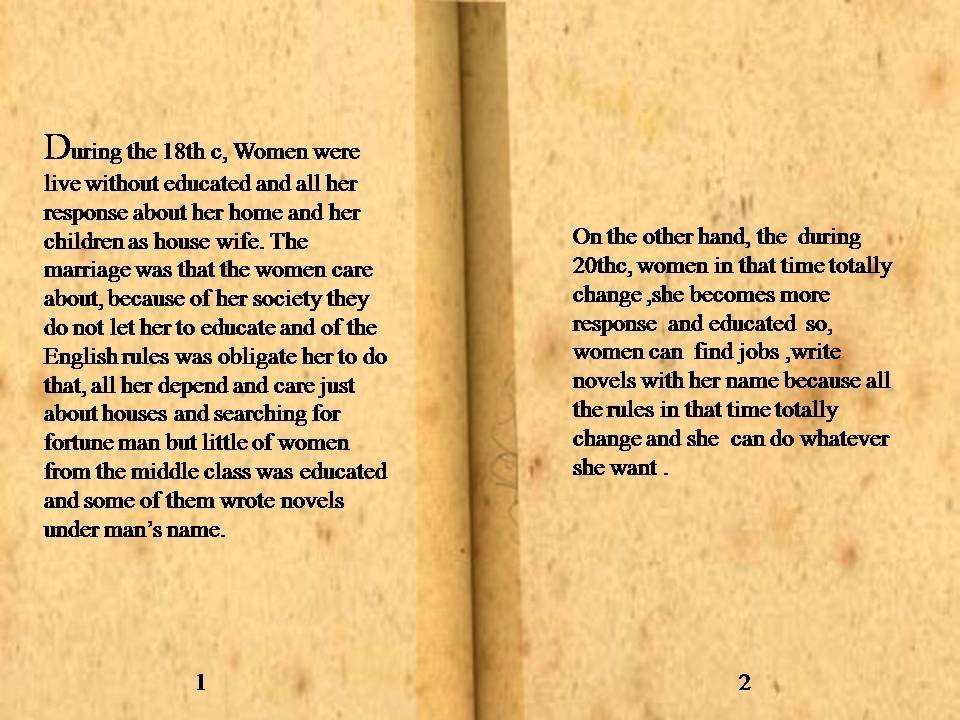 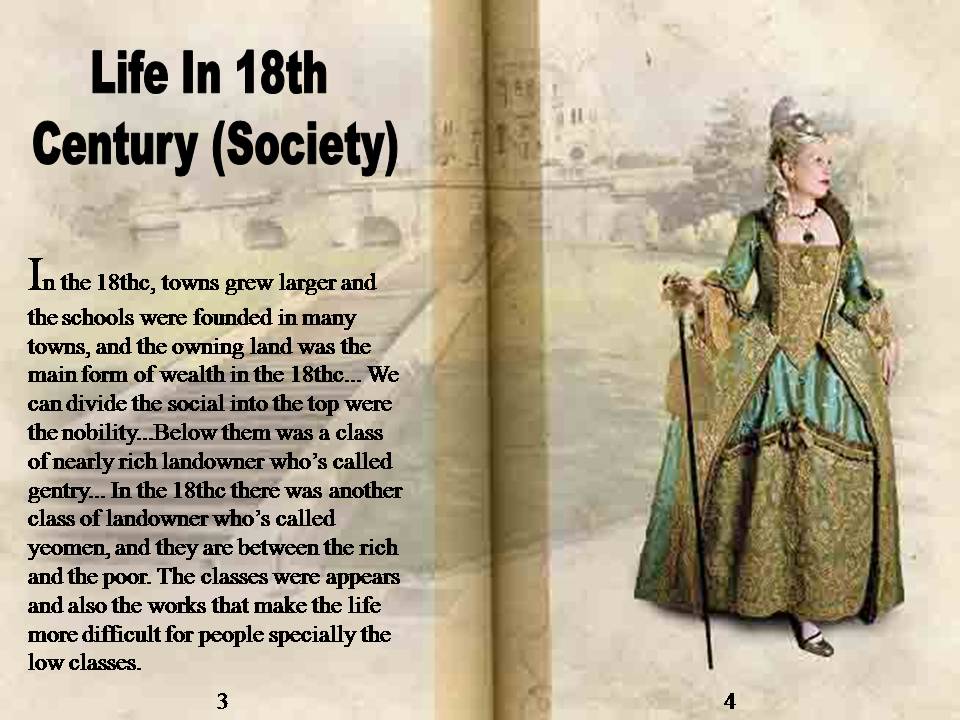 |
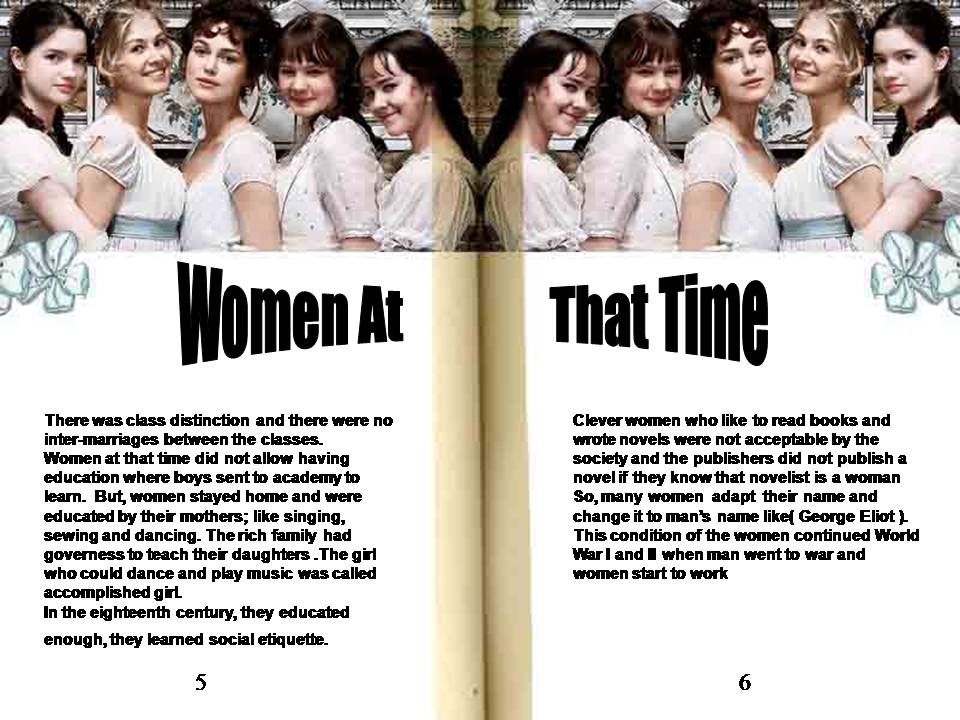
There was class
distinction and there were no inter-marriages between the classes. Women were not allowed to be educated in academies where men were sent to learn. But, women stayed home and were educated by their mothers to sing, sew and dance. Rich families had governesses to teach their
daughters .The girl who could dance and play music was called an accomplished
girl. In the eighteenth century, women were educated enough, they learned social etiquette.
Clever women who like to read books and wrote novels were not acceptable by the society and the publishers did not publish a novel if they know that novelist is a woman. So, many women changed their names to men's names like( George Eliot ). This was the condition of women until men went to World War I and II, and therefore women started to work
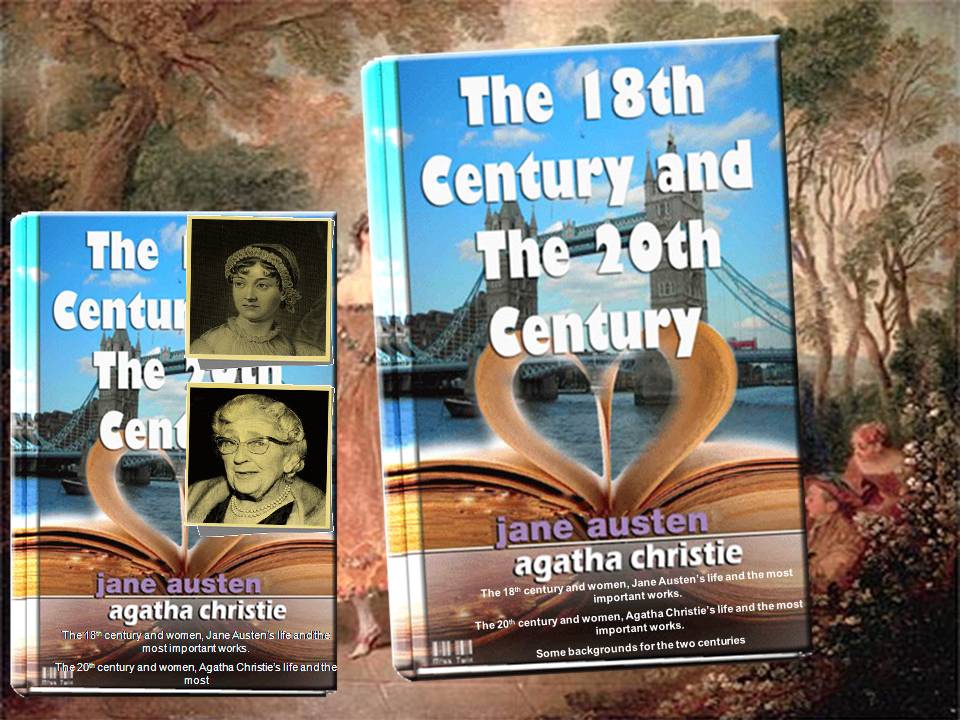
Jane Austen was a major English novelist with Fabulous and beauty in structure, made satirical fiction that marks the transition in English literature form 18th century neo-classicism to 19th century romanticism. Jane Austen was born in 1775 in village of Stevenson near Basingstoke in Hampshire. She was educated .Mr. Austen was encouraged his daughter to write. Her father made a library to her for her books. | 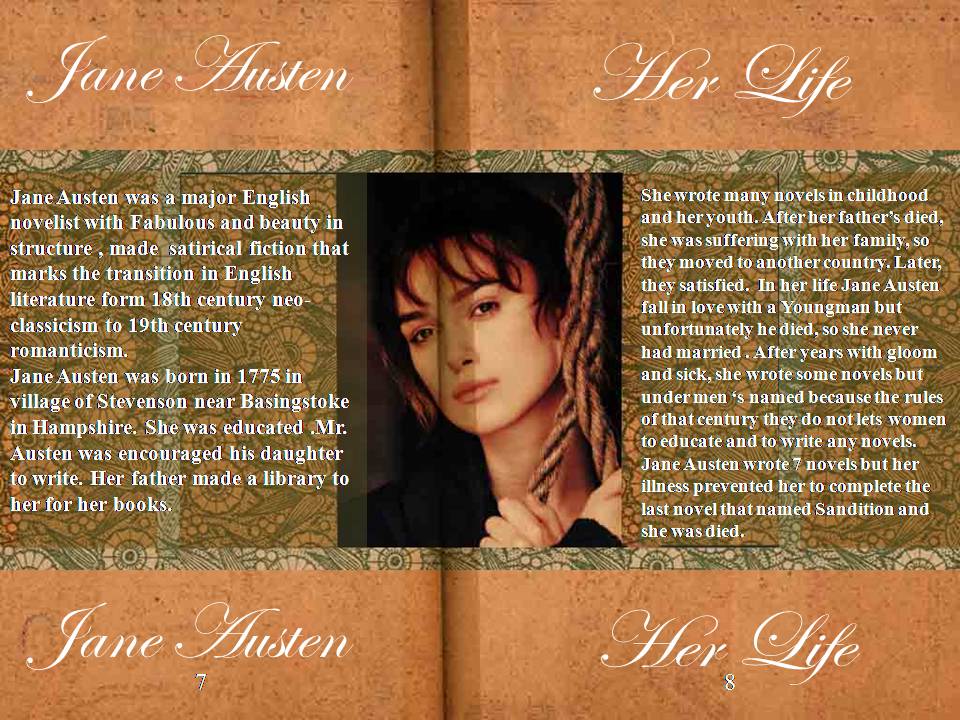 |
She wrote many novels in childhood and her youth. After her father’s died, she was suffering with her family, so they moved to another country. Later, they satisfied. In her life Jane Austen fall in love with a Youngman but unfortunately he died, so she never had married. After years with gloom and sick, she wrote some novels but under men‘s named because the rules of that century they do not lets women to educate and to write any novels. Jane Austen wrote 7 novels but her illness prevented her to complete the last novel that named Sandition and she was died...
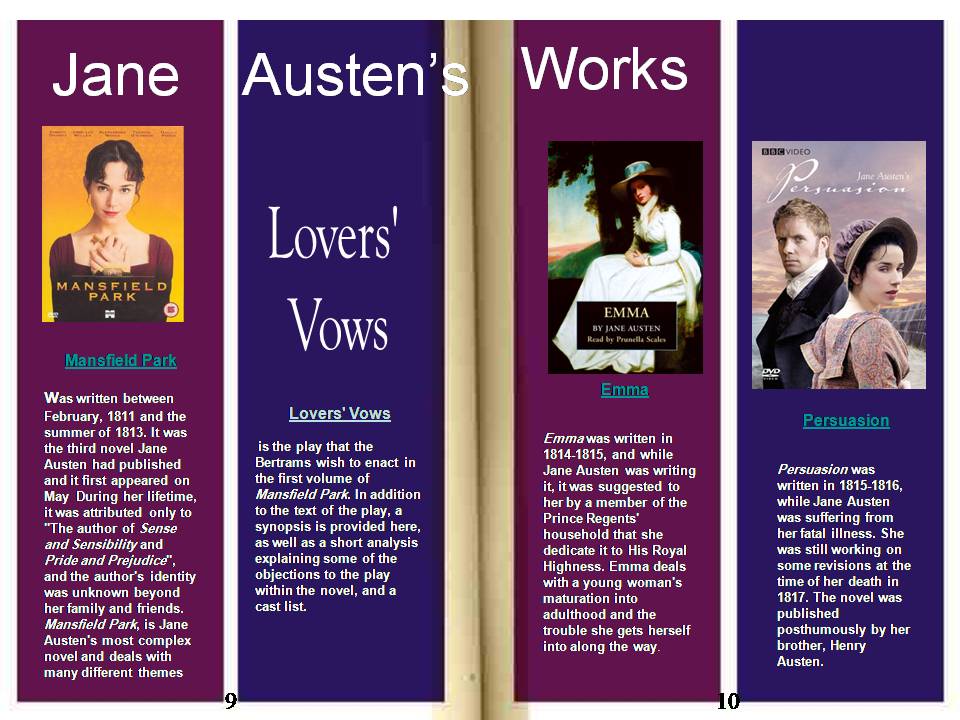
Jane Austen's Works:
· Mansfield Park was written between February, 1811 and the summer of 1813. It was the third novel Jane Austen had published and it first appeared on May during her lifetime, it was attributed only to "The author of Sense and Sensibility and Pride and Prejudice", and the author's identity was unknown beyond her family and friends. Mansfield Park, is Jane Austen's most complex novel and deals with many different themes
· Lovers' Vows is the play that the Bertrams wish to enact in the first volume of
· Emma was written in 1814-1815, and while Jane Austen was writing it, it was suggested to her by a member of the Prince Regents' household that she dedicates it to His Royal Highness. Emma deals with a young woman's maturation into adulthood and the trouble she gets herself into along the way.
- Persuasion was written in 1815-1816, while Jane Austen was suffering from her fatal illness. She was still working on some revisions at the time of her death in 1817. The novel was published posthumously by her brother, Henry Austen.
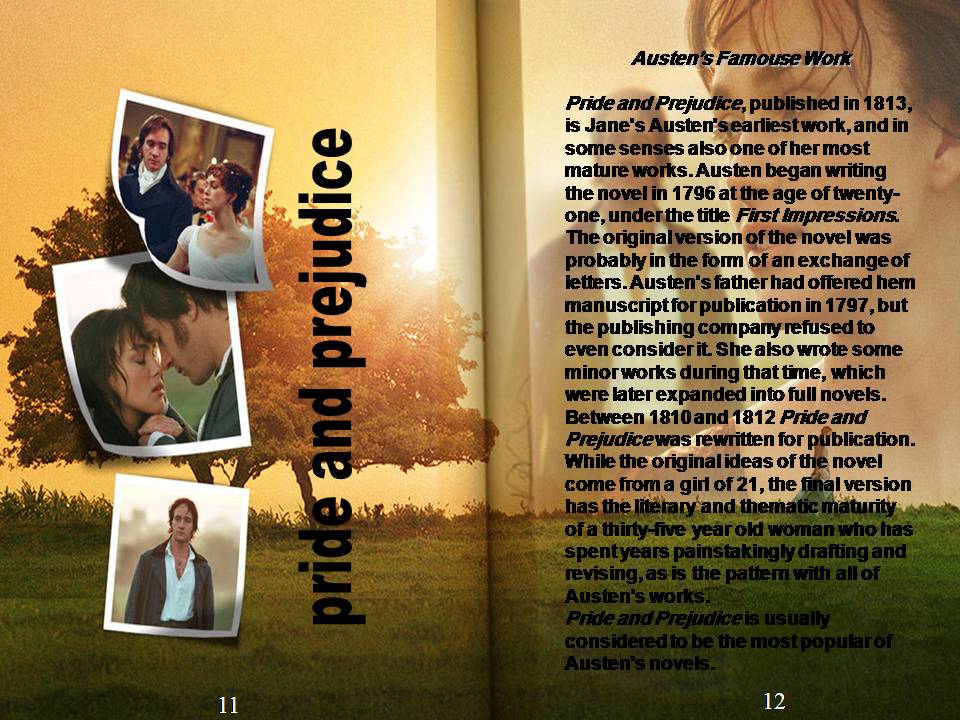
Austen’s Famous Work
Pride and Prejudice, published in 1813, is Jane's Austen's earliest work, and in some senses also one of her most mature works. Austen began writing the novel in 1796 at the age of twenty-one, under the title First Impressions. The original version of the novel was probably in the form of an exchange of letters. Austen's father had offered hem manuscript for publication in 1797, but the publishing company refused to even consider it. She also wrote some minor works during that time, which were later expanded into full novels.
Between 1810 and 1812 Pride and Prejudice was rewritten for publication. While the original ideas of the novel come from a girl of 21, the final version has the literary and thematic maturity of a thirty-five year old woman who has spent years painstakingly drafting and revising, as is the pattern with all of Austen's works.
Pride and Prejudice is usually considered to be the most popular of Austen's novels.
what really changed society was the start of world war I in 20th century, there were about five million people in the army and royal; air force formed from the RNAS and RFC , was about the same size of the pre-war army the three million was known as "lost generation",", and there is a numbers left society scarred , some people felt their sacrifice was little regarded in Britain conscription brought people from many different classes, and also people from all over upper class , together and this mixing was seen as a great equal which make the society changed after war .
|  |
The reforms of the previous century continued the social reforms in 20 the century continued with the Labor Party, but this did not make success until the general election1922. in 1918 the representation give the women’s the writ of volt but the equal suffrage was achieved in1928.after that post-war boom soon led to a depression specially in north of England and Wales which unemployment reached 70% The General Strike called during 1926 but little improved, the Strike continued and often seen as the start of the slow decline of the British coal industry.
And then the second world war is regard as continuation of first world war after a period of peace but the conflicts was significantly different, particularly for British society The war started with a phony war in of major threats did not materialize but thousands of children were moved from the cities into the country Ten times the number of children were evacuated in 1939 , and then The focus on agriculture to feed the people gave some people their first introduction to the countryside, and women played an important part in the war as the Land Girls there were also half a million women in the armed forces, with even Princess Elizabeth, the future queen, training as a driver , the freedom of women came through these jobs , and working in factories in the jobs of male workers is considered as contributing to the later sexual revolution.
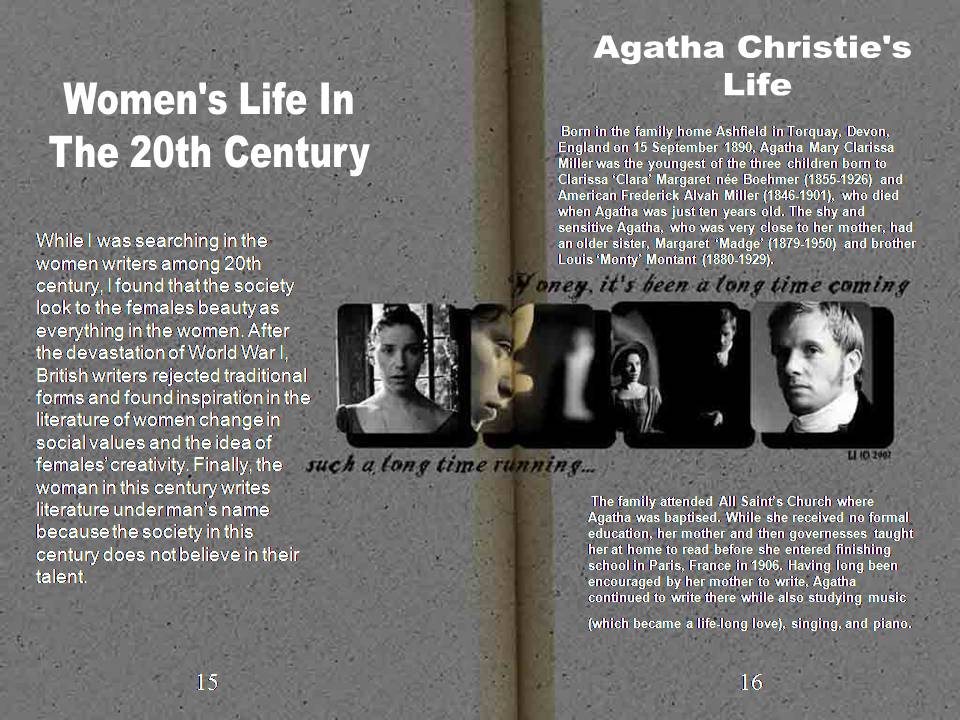
Women's Life in the 20th Century
While I was searching in the women writers among 20th century, I found that the society look to the females beauty as everything in the women. After the devastation of World War I, British writers rejected traditional forms and found inspiration in the literature of women change in social values and the idea of females’ creativity. Finally, the woman in this century writes literature under man’s name because the society in this century does not believe in their talent.
Agatha Christie's Life
She born in the family home Ashfield in Torquay, Devon, England on 15 September 1890, Agatha Mary Clarissa Miller was the youngest of the three children born to Clarissa ‘Clara’ Margaret née Boehmer (1855-1926) and American Frederick Alvah Miller (1846-1901), who died when Agatha was just ten years old. The shy and sensitive Agatha, who was very close to her mother, had an older sister, Margaret‘Madge’ (1879-1950) and brother Louis ‘Monty’ Montant (1880-1929). The family attended All Saint’s Church where Agatha was baptized. While she received no formal education, her mother and then governesses taught her at home to read before she entered finishing school in
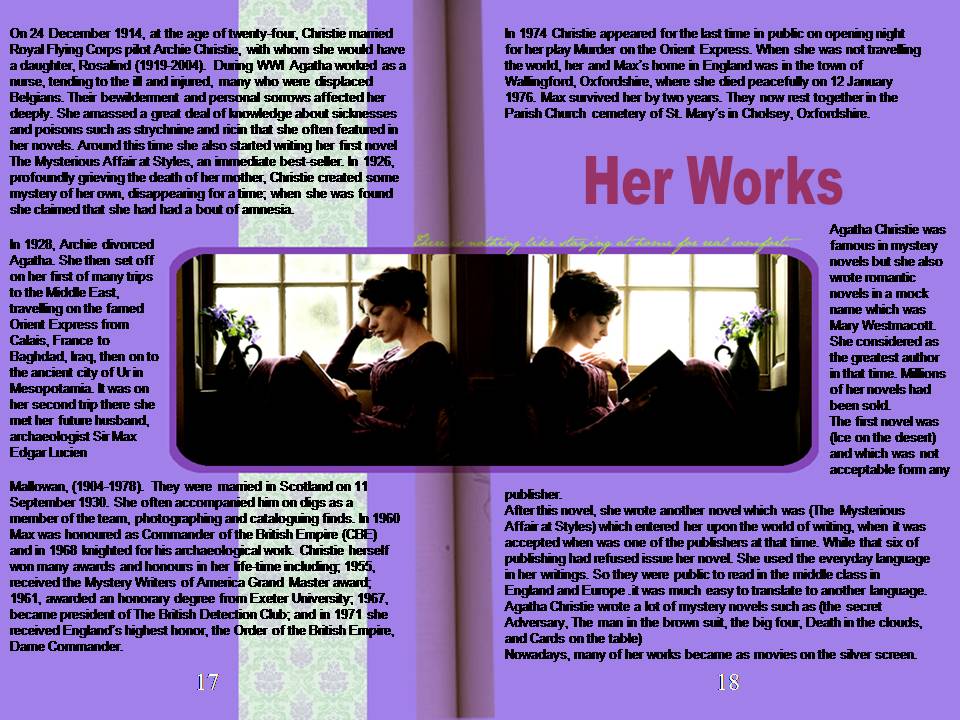
On 24 December 1914, at the age of twenty-four, Christie married Royal Flying Corps pilot Archie Christie, with whom she would have a daughter, Rosalind (1919-2004). During WWI Agatha worked as a nurse, tending to the ill and injured, many who were displaced Belgians. Their bewilderment and personal sorrows affected her deeply. She amassed a great deal of knowledge about sicknesses and poisons such as strychnine and ricin that she often featured in her novels. Around this time she also started writing her first novel The Mysterious Affair at Styles, an immediate best-seller. In 1926, profoundly grieving the death of her mother, Christie created some mystery of her own, disappearing for a time; when she was found she claimed that she had had a bout of amnesia.
In 1928, Archie divorced Agatha. She then set off on her first of many trips to the Middle East, travelling on the famed Orient Express from
In 1974 Christie appeared for the last time in public on opening night for her play Murder on the Orient Express. When she was not travelling the world, her and Max’s home in
Her Works
Agatha Christie was famous in mystery novels but she also wrote romantic novels in a mock name which was Mary Westmacott. She considered as the greatest author in that time. Millions of her novels had been sold. The first novel was (Ice on the desert) and which was not acceptable form any publisher. After this novel, she wrote another novel which was (The Mysterious Affair at Styles) which entered her upon the world of writing, when it was accepted when was one of the publishers at that time. While that six of publishing had refused issue her novel. She used the everyday language in her writings. So they were public to read in the middle class in
Conclusion
The pattern of
I. The Peasants
Since society was still mostly rural in the eighteenth century, the peasantry constituted the largest social group; there were rather wide differences, however, between peasants from area to area.
II. The Nobility
The nobles, who constituted about 2 or 3 percent of the European population, played a dominating role in society. Being born a noble automatically guaranteed a place at the top of the social order, with all of its attendant special privileges and rights. The legal privileges of the nobility included judgment by their peers, immunity from severe punishment, exemption from many forms of taxation, and rights of jurisdiction. Especially in central and eastern
III. The Aristocratic Way of Life
The Country House
The English country house is generally accepted as a large house or mansion, once in the ownership of an individual who also usually owned another great house in town allowing one to spend time in the country and in the city.
The Grand Tour
Aspect of eighteenth-century travel was the Grand Tour in which the sons of aristocrats completed their educations by making a tour of
One other hand, The Twentieth Century Society was founded as the Thirties Society in 1979 – the year the Thirties exhibition was shown at the Hayward Gallery. The need for a specialized conservation society covering the period after 1914 (the limit of the scope of the Victorian Society, founded twenty years earlier) was increasingly appreciated in the 1970s as understanding and awareness of twentieth century design was developing. The name of the new society did not come easily. Eventually ‘The Thirties Society’ was chosen, since that decade was fashionable, but from the beginning, our mission was described as ‘to protect architecture and design after 1914’. The Thirties Society was therefore dedicated to promoting and protecting the best work of the 1920s and 1930s regardless of style; that is, not just Modern but Modernistic, Classical, Neo-Georgian, Pseudish , Gothic, and even Stockbrokers’ Tudor as well. And it was not long before post-1939 buildings at risk also presented themselves for consideration, the first such case being the National Union of Mineworkers Building in
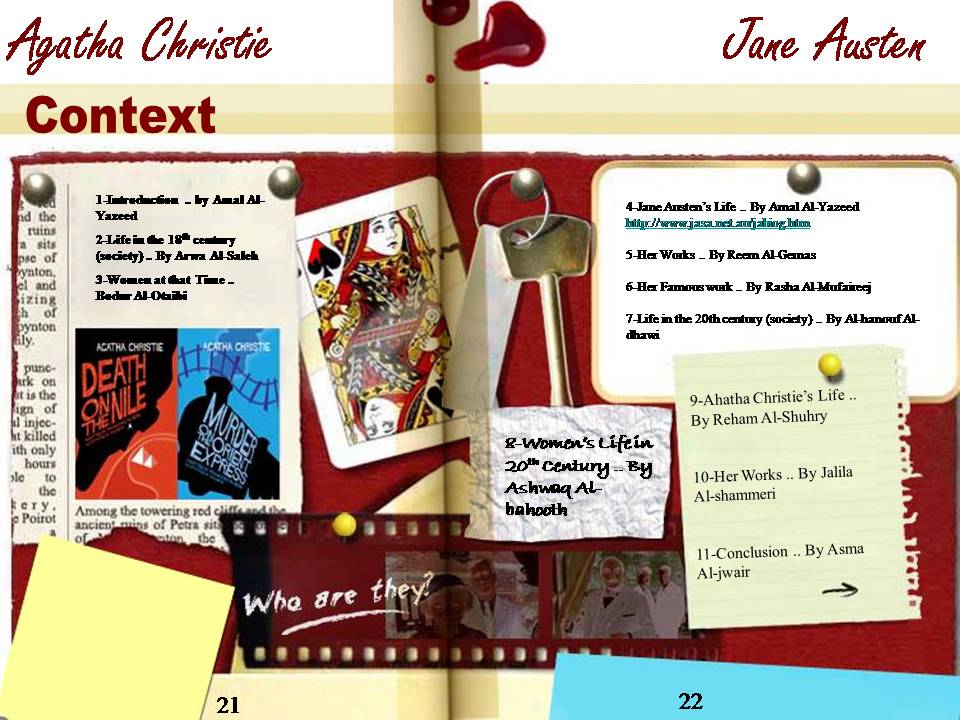
written by:
Amal Al-Yazeed , Arwa Al-Saleh , Bodur Al-Otaibi , Amal Al-Yazeed
Reem Al-Gernas , Rasha Al-Mukharrej, Al-hanouf Al-dhawi, Ashwaq Al-bahooth , RehamAl-Shuhry ,Jalila Al-shammeri , Asma Al-jwair
http://www.jasa.net.au/jabiog.htm
